AccurateAI · open source
AI products,
built in plain sight.
Open-source AI for healthcare access, enterprise governance, and clinical decision-support. Each project ships with its adversarial eval, its safety net, and its source — by Sankar Subbayya.
Projects
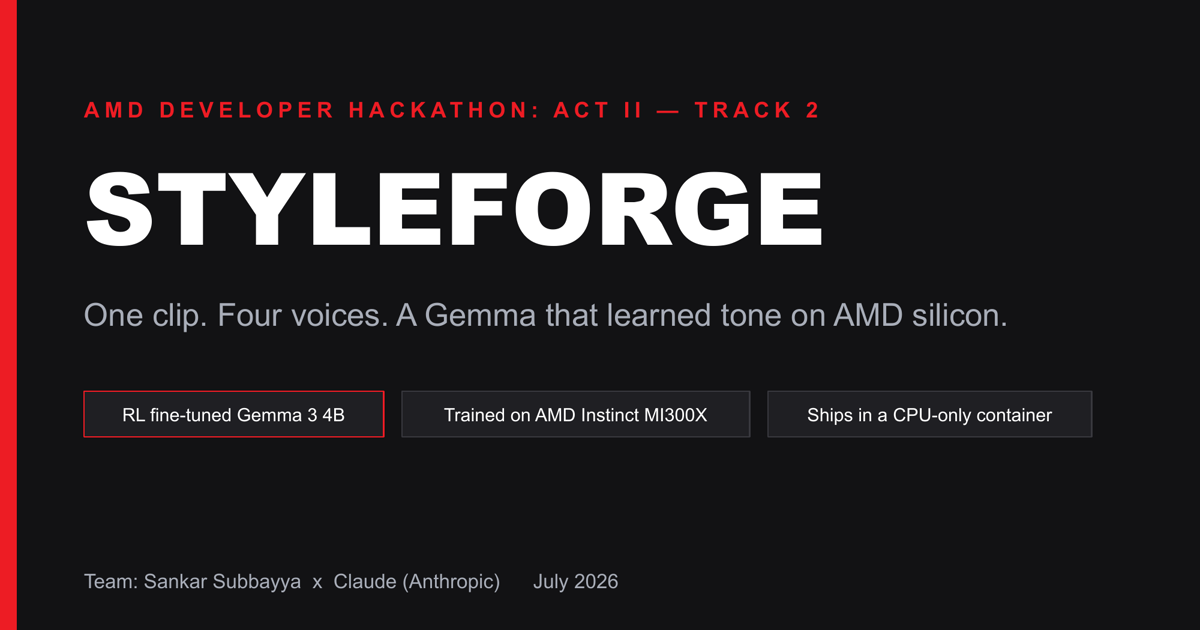
StyleForge
AMD Developer Hackathon ACT II · July 2026One clip, four voices. A video-captioning agent whose sense of tone was trained, not prompted: a Gemma 3 4B fine-tuned with DPO across three measured rounds on an AMD Instinct MI300X — reaching frontier-model parity on caption accuracy and beating the ~1T-class frontier outright on non-tech humor — shipped inside a survival-first container that writes valid output from its first second of execution. Scored top-10 of 38+ teams on the official hidden-set leaderboard, with every regression diagnosed, published, and rolled back by digest. Measured, not mythologized.
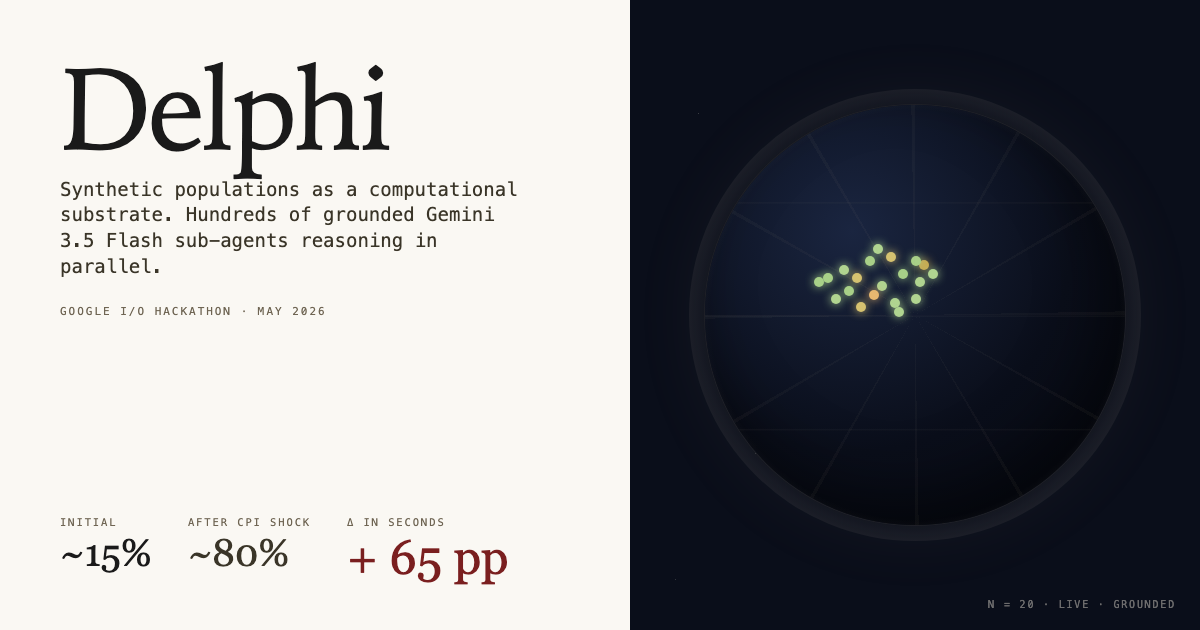
Delphi
Google I/O Hackathon · May 2026Synthetic populations as a computational substrate. You ask any question — 'will the Fed cut rates?', 'pretest this tagline', 'stress-test this decision' — and dozens of Gemini 3.5 Flash sub-agents, each role-playing a different American persona generated from US Census demographics and grounded in live web, reason in parallel. In ~60 seconds you get a probabilistic forecast, the strongest reasons for and against, where demographics diverge, and a striking outlier quote — synthesized into a Wall Street Journal–style summary by a final Gemini call. Live-demoed with a sixty-percentage-point swing on one news shock.
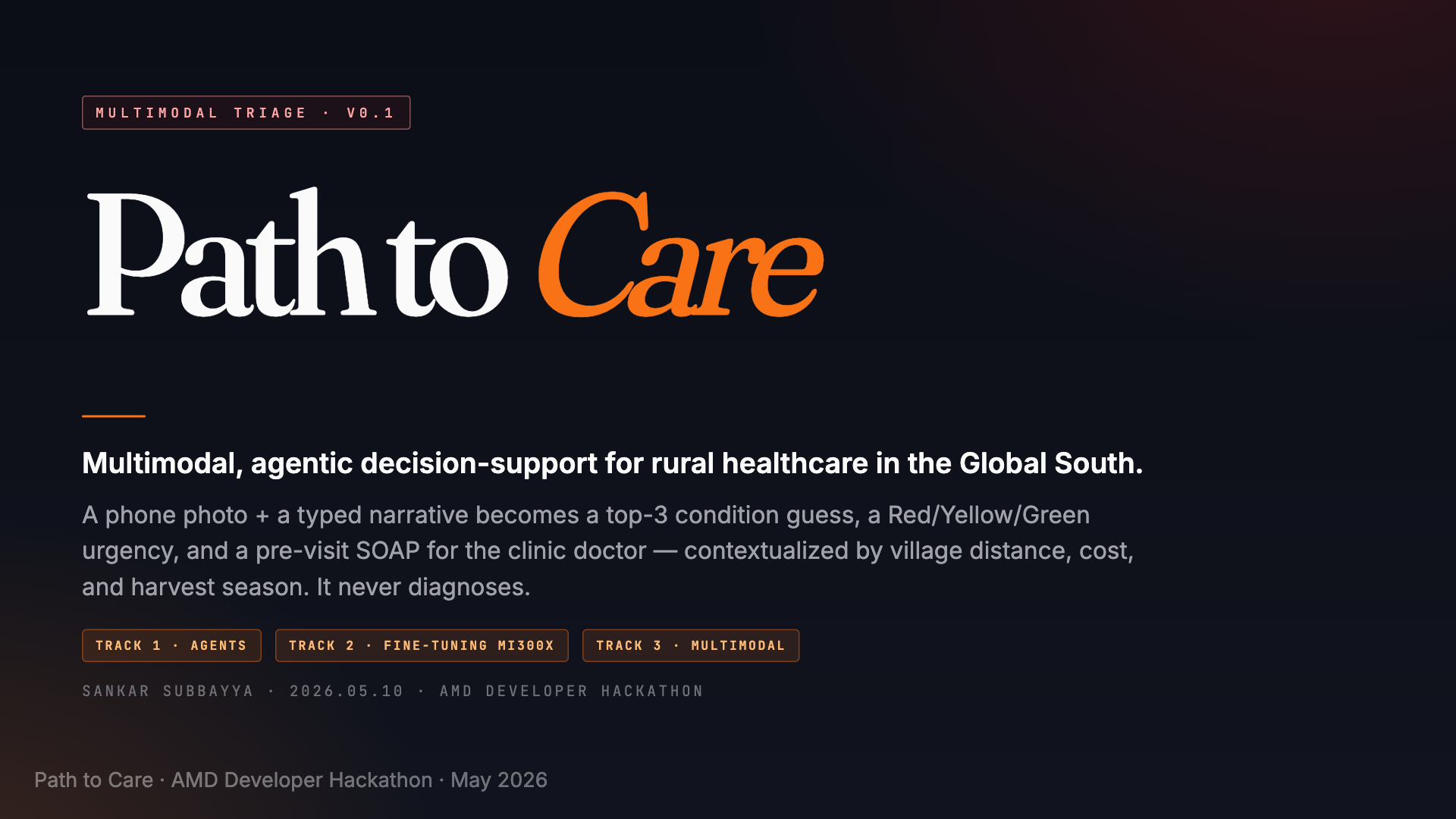
Path to Care
AMD Developer Hackathon · May 2026Multimodal, agentic triage decision-support for rural healthcare in the Global South. A phone photo plus a typed narrative becomes a top-3 condition guess, a Red/Yellow/Green urgency, and a structured pre-visit SOAP for the clinic doctor — contextualized by village distance, cost, and harvest season. Built in 24 hours on a single AMD Instinct MI300X. Never diagnoses.
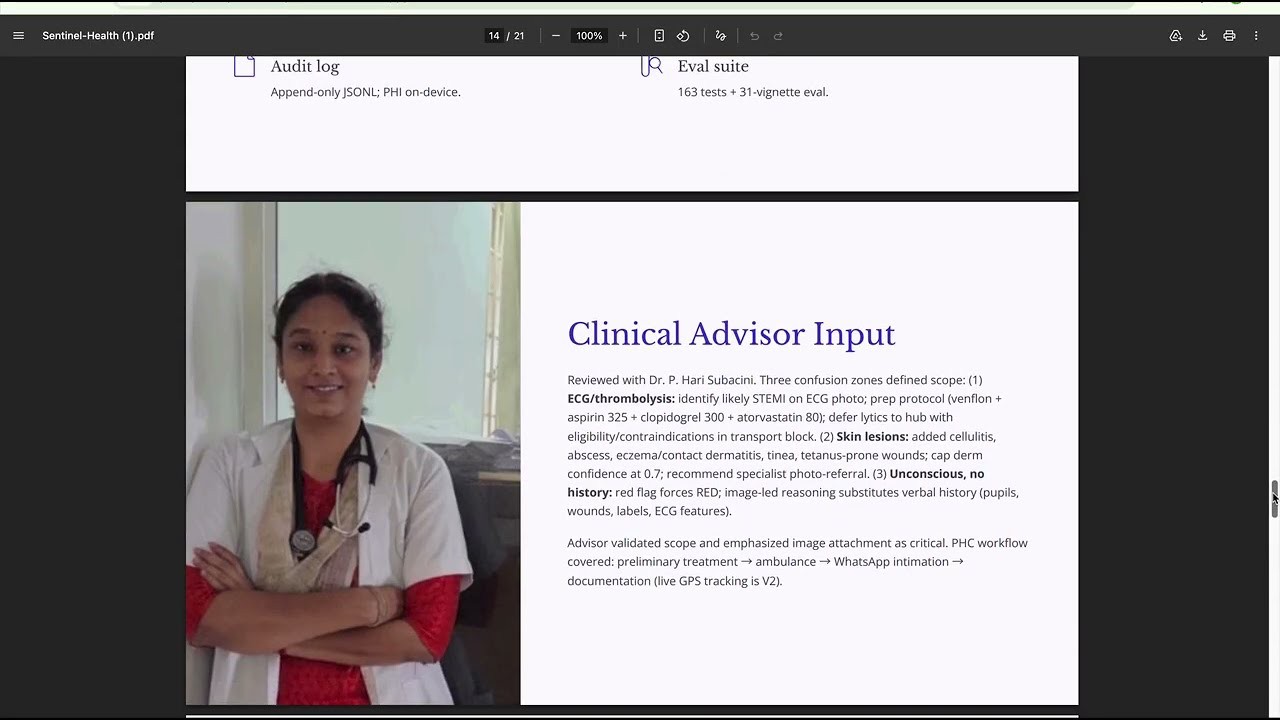
Sentinel Health
Gemma 4 Good Hackathon · May 2026Offline triage for community health workers in low-resource settings. Multimodal Gemma 4 + a deterministic safety layer + a WhatsApp handoff to the hub physician — runs entirely on a clinic laptop, no internet. Scoped to five grassroots emergencies: trauma, poisoning, snake bite, MI, stroke.
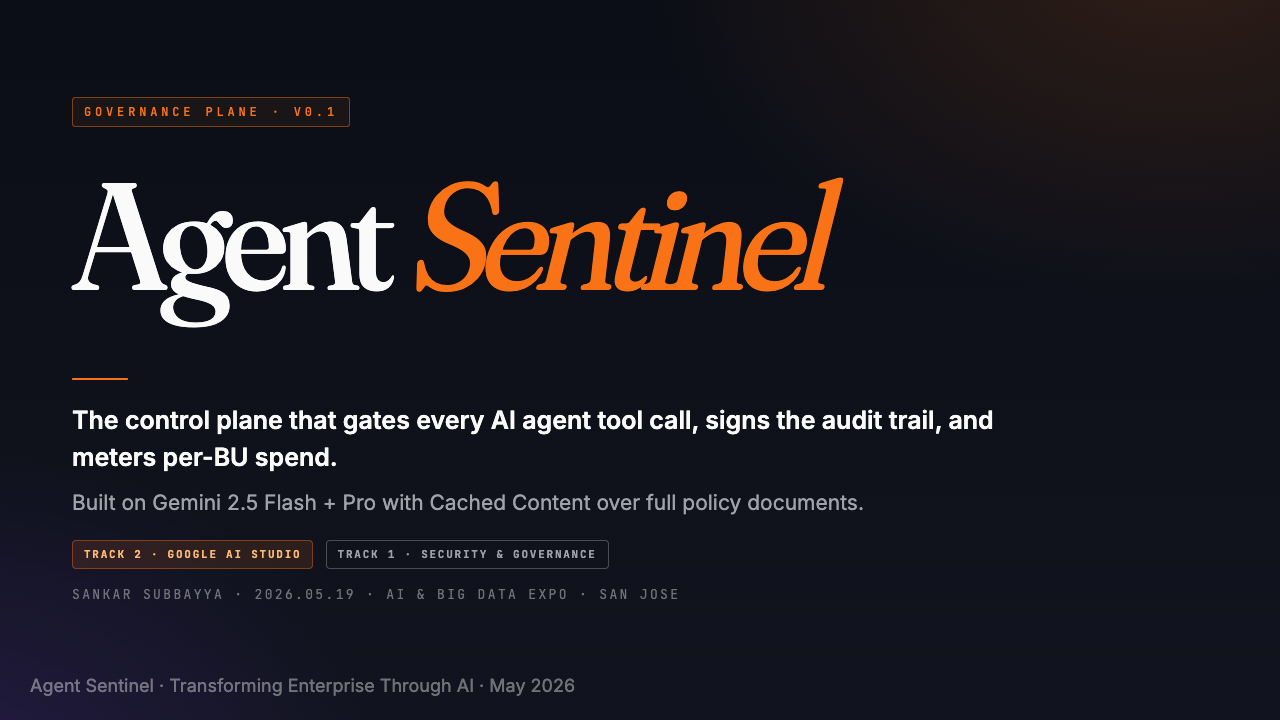
Agent Sentinel
AI & Big Data Expo · San Jose · May 2026Governance plane for enterprise AI agents. Gates every tool call, signs the audit trail with hash-chained HMAC, and meters per-BU spend. Built on Gemini 2.5 Flash + Pro with Cached Content over full policy documents. The control plane between agentic pilots and production.
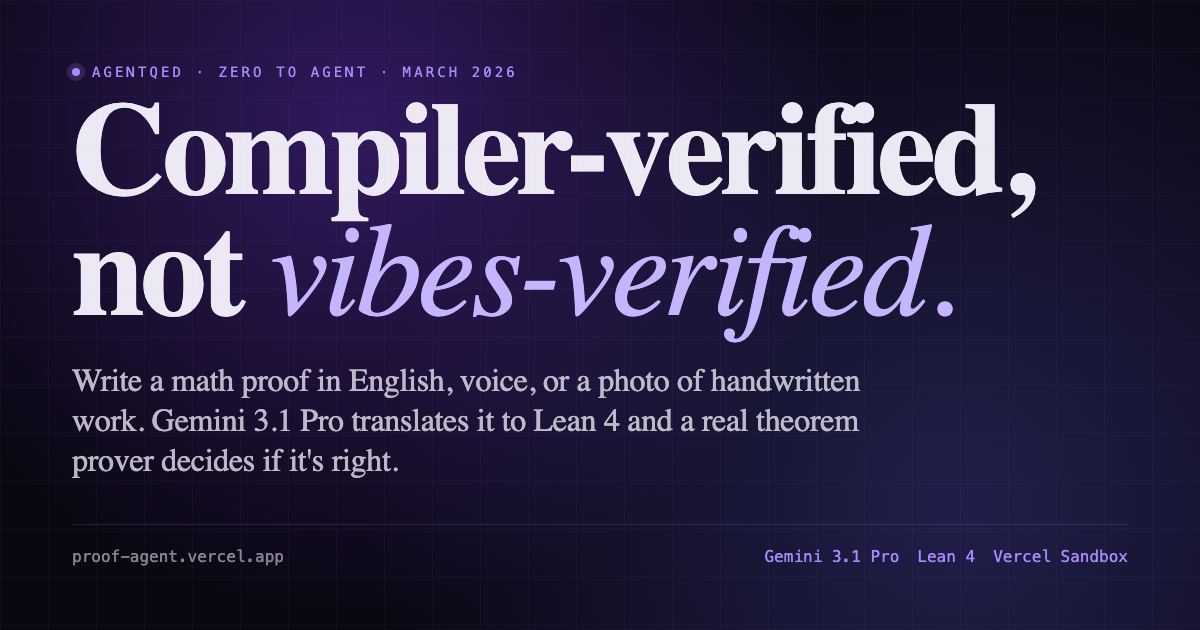
AgentQED
Zero to Agent Hackathon · Vercel × DeepMind · March 2026From an idea by Ganesh Sankar (UC Berkeley). Translate a math proof in plain English, voice, or a photo of handwritten work into Lean 4, then formally verify it with the real compiler in an isolated Firecracker microVM. Gemini 3.1 Pro writes the Lean, Vercel Sandbox runs it, and on rejection the agent reads the compiler's error and edits the proof — up to twelve times — until it typechecks. Compiler-verified, not vibes-verified.
What ties them together
Six projects, one posture: AI that names its own limits.
Path to Care never produces a diagnosis. Sentinel Health never overrides a red flag. Agent Sentinel never lets a model bypass its policy gate. Delphi never claims certainty without showing where its personas disagreed. AgentQED never accepts a proof unless the Lean compiler accepts it first. StyleForge never ships an unmeasured change — every fine-tuning round is gated by a held-out eval under an independent judge, and every scored artifact is banked by digest so a bad bet is one tag away from reversal. The safety layer is code, not a disclaimer.
Every project ships an adversarially-authored test set and a measurable safety target — zero false-negatives on Red triage for Path to Care, zero unauthorized tool calls for Agent Sentinel, reproducible demographic-divergence reporting for Delphi — plus a single-command demo. If you can't reproduce the claim on the repo, the claim doesn't count.